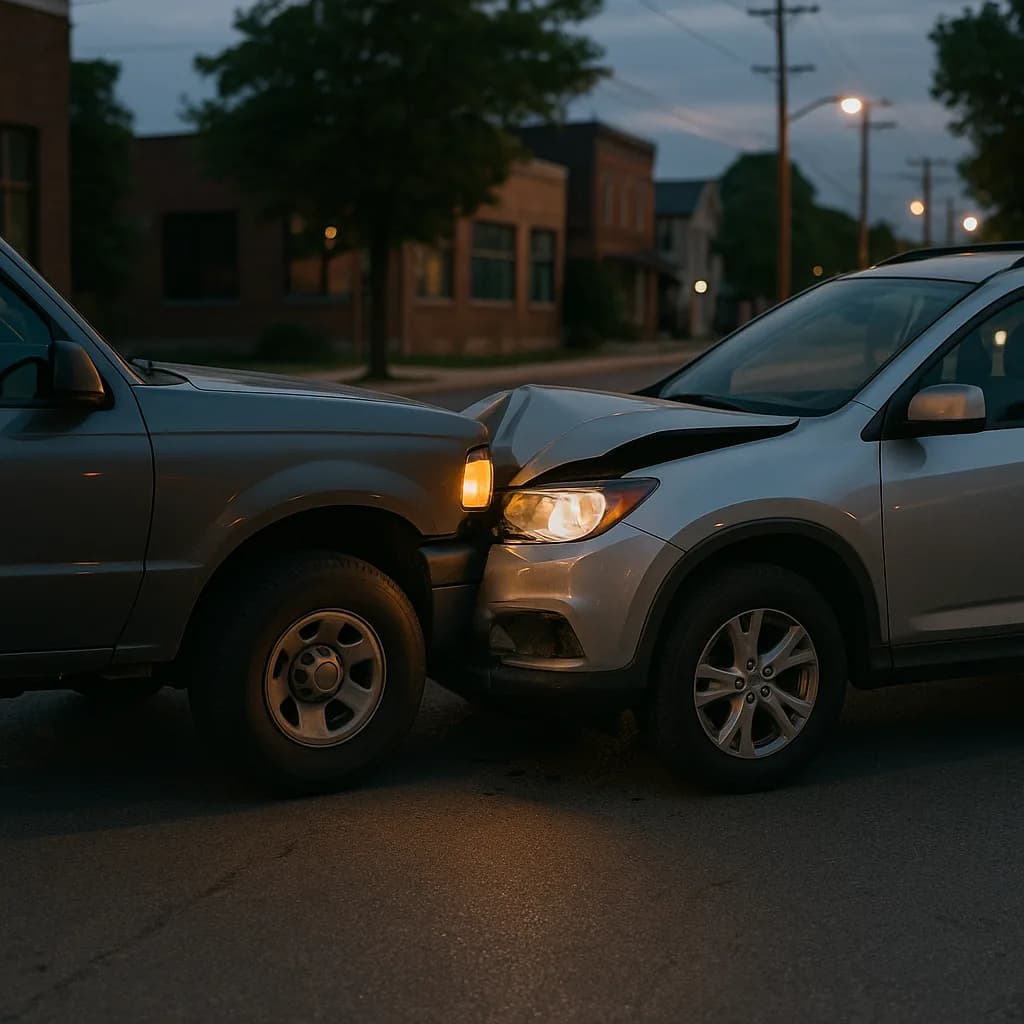
Coverage limits cap how much your insurer pays per accident. Exceed them, and you're personally liable for the rest—even if that means wage garnishment or bankruptcy.
Coverage Limits Are Payment Caps, Not Protection Caps
A coverage limit is the maximum dollar amount your insurance company will pay for a single claim or accident. If you carry $25,000 per person bodily injury liability, that's the most your insurer pays for one person's injuries in an accident you cause—even if their actual medical bills reach $80,000. You're personally responsible for the remaining $55,000.
This is the part most first-time buyers miss: your premium buys a specific dollar cap, not full protection from financial harm. The policy doesn't stretch to cover what you actually owe. It pays up to the limit you purchased, then stops. Everything beyond that limit becomes your personal debt, collectible through wage garnishment, bank account levies, or property liens in most states.
Coverage limits appear in a slash format like 25/50/25 or 100/300/100. These numbers represent thousands of dollars. A 25/50/25 policy provides $25,000 per person for bodily injury, $50,000 total per accident for all injured people, and $25,000 for property damage you cause. If you injure three people in one accident and each has $40,000 in medical bills, your insurer pays $50,000 total (the per-accident cap), leaving you liable for $70,000.
What Actually Happens When You Exceed a Limit
The injured party or their insurance company will pursue you directly for the amount your policy didn't cover. This isn't a maybe—it's standard practice. Their insurer pays their bills first, then comes after you through a process called subrogation to recover what your policy should have paid.
You'll typically receive a demand letter within 60 to 90 days of the accident. If you don't pay or negotiate a settlement, the claim moves to civil court. A judgment against you allows the creditor to garnish up to 25% of your disposable income in most states, place liens on property you own, or seize funds from bank accounts. These judgments remain enforceable for 10 to 20 years depending on state law, and many can be renewed indefinitely.
Bankruptcy doesn't always eliminate these debts. If the court determines you caused the accident through willful or malicious conduct—such as street racing or driving under the influence—the debt may survive bankruptcy proceedings. Even standard negligence judgments require you to navigate Chapter 7 or Chapter 13 processes that damage credit for seven to ten years.
Compare car insurance for first-time drivers
Rates are high for new drivers — but the right carrier and discounts can make a real difference.
Get Your Free Quote✓ New Driver Specialists✓ No Obligation✓ Licensed Carriers✓ All 50 States
Why State Minimums Create Maximum Risk for Young Drivers
Most states require liability minimums between 25/50/25 and 30/60/25. These amounts were set decades ago and haven't kept pace with medical costs or vehicle values. The average emergency room visit for a moderate injury now costs $15,000 to $25,000 before any surgery or follow-up care. A totaled 2020 midsize sedan costs $25,000 to $35,000 to replace. State minimum limits can be exhausted by a single moderate accident.
Young and first-time drivers face higher statistical risk of causing accidents—NAIC data shows drivers under 25 are involved in at-fault accidents at roughly twice the rate of drivers over 30. Pairing high accident probability with low coverage limits creates outsized financial exposure exactly when you have the fewest assets to protect and the longest earning timeline ahead of you.
Increasing from state minimum 25/50/25 to 100/300/100 liability insurance typically adds $15 to $35 per month to your premium. The coverage increase is 300% to 500% depending on the limit, while the cost increase is often 20% to 40%. This is one of the few insurance decisions where paying more delivers disproportionate value because it directly reduces the chance you'll owe money out of pocket after an accident.
How to Reverse-Engineer Your Coverage Limits
Start with the worst credible scenario, not the cheapest legal option. Calculate what you'd owe if you caused a two-car accident injuring three people who each required ambulance transport, emergency room treatment, and follow-up care. Medical costs alone could reach $60,000 to $120,000. Add vehicle damage for two cars at $30,000 to $60,000 combined. A realistic severe accident you cause could generate $100,000 to $200,000 in claims.
Now compare that exposure to your assets and income. If you're 22 with $8,000 in savings and earn $35,000 annually, you don't have enough assets to make you judgment-proof, but you have decades of income a creditor can garnish. At 25% garnishment on $2,000 monthly take-home pay, you'd lose $500 per month for years to satisfy a judgment. This is why coverage limits matter more than asset protection strategies for young drivers—you're protecting future earnings, not current wealth.
Most insurance professionals recommend 100/300/100 as a baseline for drivers with any income or assets, and 250/500/100 if you earn above median income or own property. Umbrella policies that add $1 million in coverage above your auto limits cost $15 to $25 per month but require you to carry underlying auto limits of at least 250/500/100 first.
Coverage Limits Apply Per Accident, Not Per Policy Period
Your limits reset after each separate accident. If you carry 50/100/50 and cause two unrelated accidents in the same month, you have the full limit available for each incident. The limit is per occurrence, not annual aggregate. This is different from health insurance, where you might have an annual out-of-pocket maximum.
What counts as one accident versus two depends on causal connection and timing. Rear-ending one car that pushes into another car is one accident with one set of limits applying to all injuries and damage. Rear-ending a car on Monday and sideswiping a different car on Thursday are two separate accidents with full limits available for each.
Uninsured motorist coverage and collision coverage work the same way—limits apply per accident, not per year. If you carry $50,000 uninsured motorist property damage coverage and get hit by two different uninsured drivers in separate incidents, you have $50,000 available for each claim.
When Comparing Quotes, Compare Identical Limits
Insurers quote different default limits, making price comparison misleading if you're not careful. One company might quote you 25/50/25 at $140/mo while another quotes 50/100/50 at $155/mo. The second company isn't more expensive—they're quoting better coverage. You're comparing different products.
Request quotes with identical limits across all carriers: same bodily injury, same property damage, same uninsured motorist, same deductibles. Only then can you identify which company actually costs less for the same protection. Most comparison tools let you adjust limits before running quotes, but many first-time buyers skip this step and choose based on the lowest number without checking what that number actually buys.
The other variable that distorts comparison is which coverages are included. Some quotes include uninsured motorist coverage automatically because it's required in that state. Others exclude it because it's optional. If you're comparing a quote with uninsured motorist to one without it, you're not comparing equivalent policies even if the liability limits match.