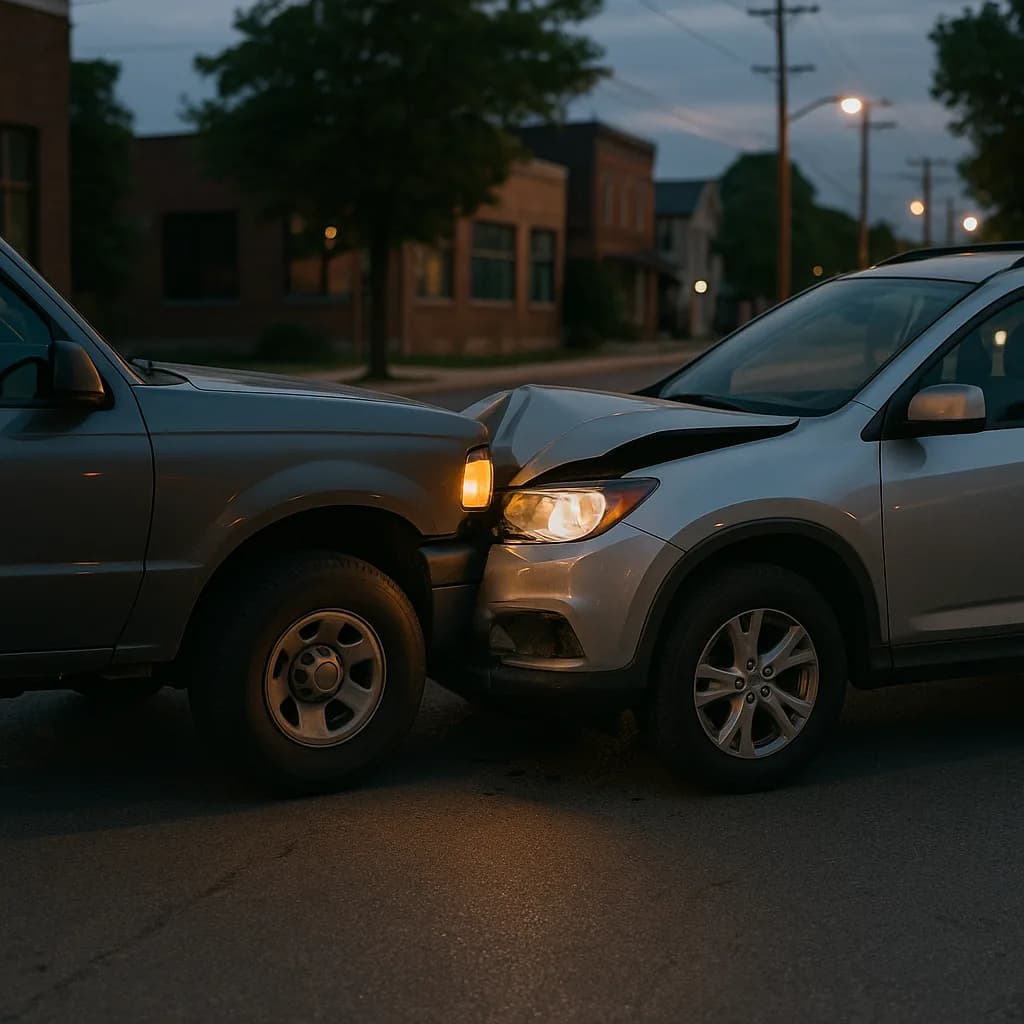
Most first-time buyers choose collision coverage based on loan requirements, not actual math. Here's how to decide if you need it based on your car's value and your deductible break-even point.
What Collision Coverage Actually Pays For
Collision insurance pays to repair or replace your car when it hits another vehicle, object, or rolls over — regardless of who caused the accident. If you back into a pole, sideswipe a guardrail, or get hit by someone without insurance, collision coverage handles your vehicle damage after you pay your deductible (the amount you pay out-of-pocket before insurance kicks in).
Unlike liability insurance, which every state requires and which pays for damage you cause to others, collision coverage is optional unless you're financing or leasing your car. Your lender requires it because they own the vehicle until you finish paying it off — they're protecting their asset, not yours.
The coverage pays up to your car's actual cash value (what it's worth today, not what you paid for it) minus your deductible. If your car is worth $8,000 and you have a $1,000 deductible, the maximum you'd receive for a total loss is $7,000. This distinction matters more than most first-time buyers realize when deciding whether to keep or drop the coverage.
The Break-Even Calculation Most Young Drivers Skip
Collision coverage for drivers under 25 typically costs between $80 and $180 per month depending on your car's value, driving record, and location. The critical question isn't whether you can afford it — it's whether keeping it makes financial sense based on your car's declining value.
Here's the math lenders won't show you: if you're paying $120/month for collision coverage with a $1,000 deductible on a car worth $6,000, you're spending $1,440 per year to protect $5,000 of value (car value minus deductible). After just three years of premiums, you've paid $4,320 — nearly as much as the maximum payout you'd receive. That's your break-even point, and it arrives faster than most drivers expect.
The calculation shifts dramatically as your car ages. A seven-year-old sedan worth $4,500 with the same $120/month premium and $1,000 deductible leaves you protecting only $3,500 of value. You'd break even in under two and a half years. Once your annual collision premium exceeds 10-15% of your car's current value, you're typically overpaying for protection.
Most insurance carriers let you adjust your deductible from $500 to $2,000. Raising it from $500 to $1,000 typically reduces your monthly premium by $15 to $30, but that higher deductible also reduces your maximum payout, accelerating the break-even timeline. Run the specific numbers for your situation before making changes.
Compare car insurance for first-time drivers
Rates are high for new drivers — but the right carrier and discounts can make a real difference.
Get Your Free Quote✓ New Driver Specialists✓ No Obligation✓ Licensed Carriers✓ All 50 States
When You Must Keep Collision Coverage
If you're still making loan payments or leasing your vehicle, you have no choice — your lender or leasing company will require both collision and comprehensive coverage until the loan is paid off. This is stated explicitly in your financing agreement, and dropping it will result in the lender purchasing expensive force-placed coverage and billing you for it.
Beyond the legal requirement, keep collision coverage if your car is worth more than $5,000 and you don't have that amount saved in an accessible emergency fund. A single at-fault accident could total your vehicle and leave you without transportation and no way to replace it. For young drivers juggling rent, student loans, and entry-level salaries, that financial gap can force you into a predatory high-interest car loan or leave you unable to get to work.
You should also keep it if you have a history of at-fault accidents. Insurance companies track your claims history for three to five years. If you've already had one at-fault collision in the past 24 months, your risk of another is statistically higher than average, and collision coverage functions as protection against a pattern, not just a single incident.
When Dropping Collision Coverage Makes Sense
Once you own your car outright and it's worth less than $4,000, the math usually favors dropping collision coverage — especially if you have a deductible of $1,000 or higher. You're protecting a small amount of value with disproportionately high premiums, and your break-even timeline may be just 18 to 24 months.
Consider this scenario: you drive a 10-year-old Honda Civic worth $3,200. Your collision premium is $95/month with a $1,000 deductible. The maximum payout after deductible is $2,200, but you'll pay $1,140 per year in premiums. You'll break even in less than two years — and by then, your car will be worth even less. Dropping collision and banking that $95/month in a dedicated car replacement fund gives you more flexibility and control.
You can also drop it if you have another reliable vehicle and could manage temporarily without this one. Many young drivers keep older cars as secondary vehicles after buying something newer. If losing the older car wouldn't prevent you from getting to work or meeting essential obligations, paying for collision coverage on it is usually inefficient.
One exception: if you're an exceptionally high-risk driver with multiple at-fault accidents or violations, collision coverage may be worth keeping longer simply because replacing a totaled vehicle will be prohibitively expensive when your rates are already elevated. In that case, the coverage functions as protection against compounding financial consequences.
How to Lower Collision Costs Before Dropping It
If you're not ready to drop collision coverage entirely but want to reduce costs, increase your deductible to $1,500 or $2,000. This typically reduces your monthly premium by 15% to 25%, though it also means you'll pay more out-of-pocket if you file a claim. Only raise your deductible to an amount you could realistically pay if your car were totaled tomorrow.
Another option: ask about usage-based insurance programs that monitor your driving through a mobile app or plug-in device. Safe driving scores can reduce your overall premium by 10% to 30%, which includes collision coverage. These programs specifically benefit young drivers who are statistically high-risk but individually safe — you're using data to override the age-based assumptions that make your rates expensive.
Finally, compare quotes annually. Collision coverage pricing varies significantly across carriers, and the insurer offering the best rate when you were 19 may not be competitive now that you're 23 with a clean record. Getting quotes from at least three carriers takes about 20 minutes and can reveal monthly savings of $40 to $80 without changing your coverage.
What Happens After You Drop Collision Coverage
Once you remove collision coverage, you're responsible for 100% of your vehicle repair costs if you cause an accident or hit an object — even if the damage is minor. A fender bender that would have cost you a $1,000 deductible could now cost $3,500 out-of-pocket. There's no reversing this decision after an accident occurs.
You'll still carry liability insurance, which is legally required in nearly every state and covers damage you cause to other people and their property. You can also keep comprehensive coverage, which costs significantly less than collision and covers non-collision events like theft, vandalism, hail, and hitting an animal. Many drivers drop collision but keep comprehensive because the cost-benefit ratio remains favorable even on older cars.
If you later decide you want collision coverage back — perhaps because you've moved to an area with heavy traffic or harsh winter conditions — you can add it during your policy renewal or by contacting your insurer mid-term. Your rate will be based on your current age, driving record, and car value at that time.