Most new drivers pick liability limits based on what's cheapest per month. This guide shows you how to choose by comparing real accident scenarios to your financial exposure — a method most agents skip.
Why the State Minimum Usually Isn't Enough
You're looking at your first quote and see two numbers that look almost identical per month: state minimum coverage at $85/mo and 100/300/100 limits at $112/mo. The $27 difference feels significant when you're budgeting your first policy, but those numbers represent completely different levels of protection in a real accident.
Liability limits control how much your insurance company pays when you cause an accident. The format is three numbers: bodily injury per person / bodily injury per accident / property damage. A state minimum in California of 15/30/5 means $15,000 maximum per injured person, $30,000 maximum per accident for all injuries combined, and $5,000 for property damage. If you rear-end someone at a red light and they go to the emergency room with neck injuries, you could hit that $15,000 limit before they even leave the hospital.
The average emergency room visit for a car accident injury costs between $3,200 and $7,600 depending on severity, according to the National Safety Council. Ambulance transport adds $400–$1,200. If imaging is required, add another $1,500–$3,000. A single moderate injury can exceed minimum limits before any follow-up care, physical therapy, or lost wages are calculated. Everything above your limit comes directly from your bank account, your wages, or your future earnings through a lawsuit.
This is why roughly 60% of drivers nationwide carry limits higher than their state minimum even though it costs more per month. They're not paying for coverage they'll never use — they're paying to avoid financial catastrophe in a scenario that happens to approximately 1 in 15 drivers per year based on accident frequency data.
How to Calculate Your Actual Risk Exposure
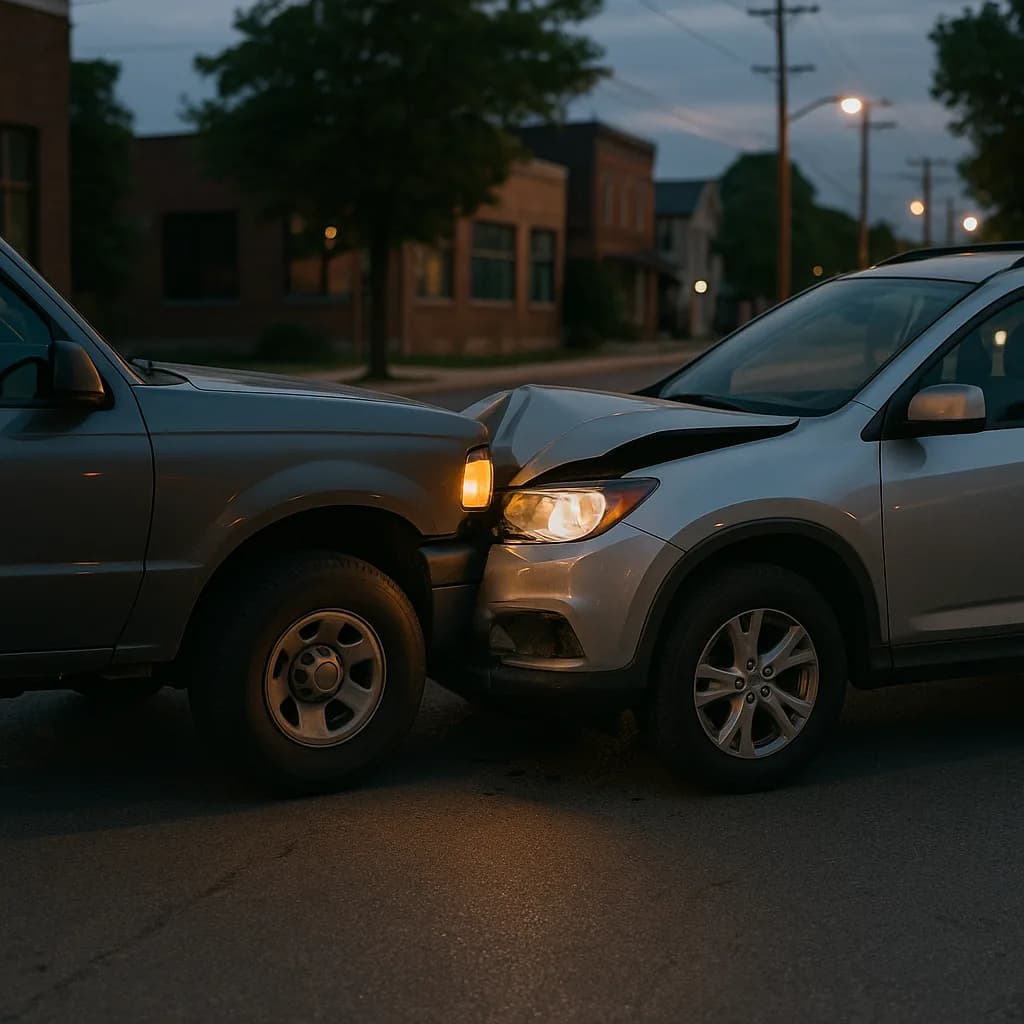
Start with the most common accident you could cause: a rear-end collision with one other vehicle at moderate speed. The other driver goes to urgent care with soft tissue injuries. Their car needs $4,500 in repairs. They miss three days of work. This is not a catastrophic accident — this is a Wednesday afternoon fender-bender that happens thousands of times per day.
With 15/30/5 state minimum limits, your insurance pays $5,000 for the car damage. The remaining repairs, medical bills, and lost wages are your responsibility. The other driver's attorney sends a demand letter for $18,000: $8,200 in medical expenses, $4,500 in vehicle repairs (you already paid $5,000 through insurance), $1,800 in lost wages, and $3,500 in pain and suffering. You now owe $13,000 out of pocket because your liability coverage stopped at $5,000 for property damage and the medical bills hit your $15,000 per-person injury limit immediately.
Now run the same scenario with 100/300/100 limits. Your insurance covers the entire $18,000 claim. You pay nothing beyond your premium. The difference in monthly cost between minimum coverage and 100/300/100 limits typically ranges from $18 to $45 per month depending on your state and driving record. Over a six-month policy term, that's $108 to $270 in additional premium to avoid a $13,000 personal liability.
Your exposure isn't just the accident itself — it's what you own and what you could earn. If you have $8,000 in savings, a car worth $6,000, and you're early in a career that could pay $45,000 annually within five years, a plaintiff's attorney sees $59,000 in recoverable assets. They will pursue a judgment for every dollar your insurance doesn't cover, and that judgment can attach to your wages for years.
Compare car insurance for first-time drivers
Rates are high for new drivers — but the right carrier and discounts can make a real difference.
Get Your Free Quote✓ New Driver Specialists✓ No Obligation✓ Licensed Carriers✓ All 50 States
The Three Coverage Tiers That Actually Matter
Forget shopping by price alone. There are three liability limit structures that align with different levels of asset protection, and each serves a specific financial profile.
State minimum coverage (typically 25/50/25 or lower) protects you only against the smallest possible accidents: single-vehicle property damage under $25,000 with minor or no injuries. This tier makes sense only if you have no savings, no valuable assets, no co-signers on loans, and wages that cannot be garnished — which describes almost no one, including new drivers. Even if you're currently a student with limited income, a judgment follows you for 10-20 years in most states, meaning it attaches to your future earning potential.
50/100/50 or 100/300/100 coverage protects you against the majority of two-car accidents with moderate injuries and property damage. This tier covers most emergency room visits, several days of hospitalization, vehicle total losses up to $50,000-$100,000, and multiple injured parties. For new drivers, 100/300/100 is the functional minimum if you have any assets worth protecting, including a financed vehicle, a college degree that signals future earnings, or parents who co-signed loans. The monthly increase over state minimum typically ranges from $20 to $50 depending on your state and age.
250/500/100 or higher coverage protects against severe multi-vehicle accidents, catastrophic injuries, or accidents involving high-value vehicles. This tier is appropriate if you have significant assets (home equity, investments, substantial savings) or high income that makes you a target for larger lawsuits. For most first-time drivers under 25, this level exceeds necessary protection unless you have unusual asset exposure, but it becomes relevant as your career advances.
The decision point isn't "what can I afford per month" — it's "what would bankrupt me in an accident." If a $30,000 judgment would devastate your finances, you need enough coverage to prevent that scenario from reaching your personal assets.
Medical Payments and Uninsured Motorist Coverage
Liability limits protect other people when you cause an accident. Two other coverage types protect you and your passengers, and new drivers frequently skip them because they don't understand the gap.
Medical payments coverage (MedPay) pays for your injuries and your passengers' injuries regardless of who caused the accident, up to your selected limit — typically $1,000 to $10,000. This coverage pays immediately, before health insurance, and covers deductibles and co-pays your health plan won't. If you're in an accident and go to the emergency room, MedPay pays the bill directly rather than forcing you to wait for a liability settlement or file against your health insurance. For new drivers, $5,000 in MedPay typically adds $3 to $8 per month and eliminates out-of-pocket medical costs for minor to moderate injuries.
Uninsured motorist coverage (UM) protects you when someone without insurance hits you. Approximately 13% of drivers nationally are uninsured according to the Insurance Research Council, with rates exceeding 20% in states like Florida, Mississippi, and New Mexico. If an uninsured driver runs a red light and hits you, their lack of coverage doesn't reduce your medical bills or lost wages — it just means no one pays them unless you have UM coverage. Your UM limits should match your liability limits: if you carry 100/300/100 liability, carry 100/300 UM so you're protected to the same degree whether the at-fault driver has insurance or not.
Some new drivers assume their health insurance covers car accidents, but health plans frequently include subrogation clauses that require you to repay them from any settlement you receive. MedPay pays first and doesn't require repayment, which means you keep more of any settlement. UM coverage fills the gap when the other driver has no ability to pay, which is a common scenario in accidents involving other young or high-risk drivers who are more likely to be uninsured or underinsured.
How Your Limits Affect Your Rate Over Time
There's a counterintuitive relationship between coverage limits and long-term costs that most new drivers miss: higher limits often lead to lower total spending after an accident.
When you cause an accident, your insurance company pays the claim up to your policy limits, then closes the file. If your limits are too low and the injured party sues you for the difference, you're now defending a lawsuit with your own money — either out of pocket or through a separate attorney. Legal defense for a personal injury case typically costs $15,000 to $40,000 even if you eventually settle, and that expense falls on you, not your insurance company, once your policy limits are exhausted.
With higher limits, your insurance company has more runway to settle claims within your policy, which means their legal team handles the entire case at no additional cost to you. A claim that settles for $75,000 within a 100/300/100 policy costs you nothing beyond your premium increase at renewal. The same claim against a 25/50/25 policy costs you $25,000 in excess liability plus legal fees to defend the claim, plus the premium increase.
Your rate after an at-fault accident typically increases 20-40% at renewal regardless of the claim amount, according to data from major carriers. A $5,000 claim and a $50,000 claim often produce similar premium increases because the rate is based on the violation (at-fault accident) rather than the dollar amount paid. This means carrying higher limits doesn't increase your rate penalty after an accident — it just ensures the entire claim is covered without personal exposure.
For new drivers, this matters more than for experienced drivers because your baseline rate is already high due to age and limited driving history. You can't afford to add a lawsuit judgment on top of your insurance premium. Paying an extra $25/mo for adequate limits prevents a scenario where you're paying $150/mo for insurance plus $200/mo toward a payment plan on a $15,000 judgment for the next six years.
What to Enter When You Get a Quote
When you request a quote online or speak with an agent, you'll be asked to select liability limits. Don't default to the pre-selected option, which is almost always state minimum or just above it.
For bodily injury liability, start with 100/300 if you have any assets or future earning potential. If you're asked whether you want 50/100, 100/300, or 250/500, the middle option is appropriate for most first-time drivers. The increase from 50/100 to 100/300 is typically $8 to $18 per month. The increase from 100/300 to 250/500 is typically $12 to $25 per month. The value is in the first jump — going from state minimum to 100/300. The second jump to 250/500 provides diminishing marginal protection unless you have significant assets.
For property damage liability, select $100,000 if available. The average new car costs over $48,000 as of 2024, and luxury vehicles and SUVs frequently exceed $70,000. If you're in an accident with two vehicles, you need enough property damage coverage to total both vehicles and any other property involved. The difference between $25,000 and $100,000 in property damage coverage is usually $6 to $12 per month.
For uninsured motorist coverage, match your liability limits. If you select 100/300 for liability, select 100/300 for UM. Some states require you to reject UM coverage in writing — don't. The cost is typically 10-15% of your liability premium, and it protects you against a scenario (uninsured at-fault driver) that's statistically more likely to involve a young or high-risk driver.
For MedPay, select at least $5,000. Some insurers offer $1,000, $2,000, $5,000, and $10,000 options. The $5,000 level covers most emergency room visits and immediate follow-up care without triggering your health insurance deductible. If you don't have health insurance or have a high-deductible plan, consider $10,000. The cost difference is minimal — usually $2 to $5 per month between tiers.
Don't let the agent or quote tool rush you into state minimum just because it shows the lowest monthly number. Ask for a quote comparison showing state minimum, 50/100/50, and 100/300/100 side by side with the monthly cost for each. The total difference is usually $40 to $70 per month between minimum and adequate coverage, which is less than one dinner out but prevents financial ruin in a single accident.