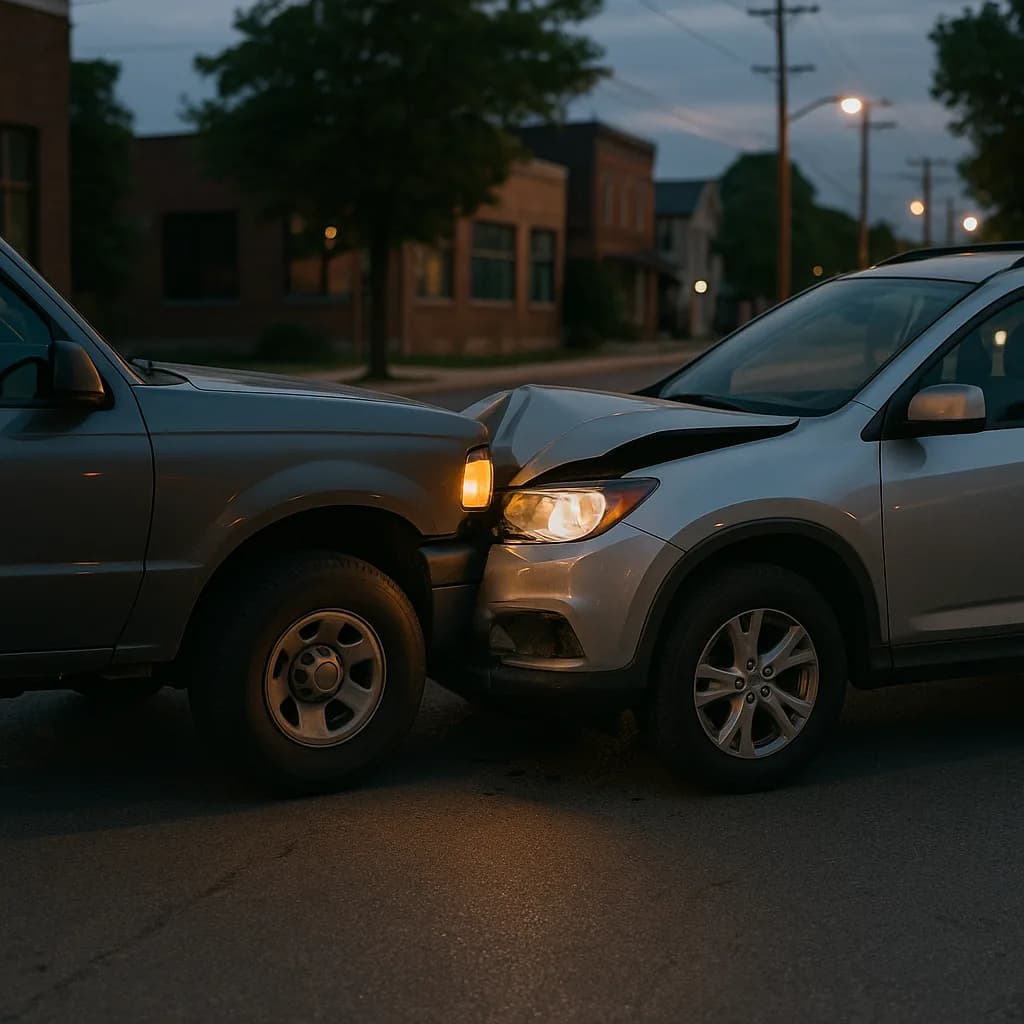
Most new drivers don't realize graduated licensing restrictions actually reduce premiums during the permit and intermediate phases — but only if you maintain them correctly and understand how violations erase the discount.
The GDL Discount Most New Drivers Miss
When you're operating under a learner's permit or intermediate license with night driving and passenger restrictions, insurers classify you differently than an unrestricted new driver — and that classification usually comes with 10-25% lower premiums during those supervised phases. The reason: restricted drivers have measurably lower accident rates. NAIC data shows GDL-restricted drivers are involved in 20-40% fewer claims than unrestricted beginners, depending on the state's specific restriction structure.
This discount applies automatically when you're listed on a parent's policy with permit or intermediate status, but it disappears the moment you upgrade to a full unrestricted license — even if your actual driving experience hasn't changed. The monthly cost for a 16-year-old with a learner's permit might run $95-$140/mo when added to a parent's policy, while the same driver with a full license averages $180-$280/mo for identical coverage limits.
The critical mistake happens when new drivers violate GDL restrictions before upgrading. A curfew violation, passenger limit violation, or any ticket issued specifically for breaking GDL terms doesn't just result in fines or license delays — it signals to insurers that you're higher risk than the restriction-compliant baseline they priced you at. Carriers typically reclassify GDL violators into the same risk tier as drivers with moving violations, which adds 15-30% to premiums for the next three years minimum.
State-Specific GDL Structures That Affect Pricing
Not all graduated licensing programs create equal insurance advantages. States with three-phase systems (learner's permit, intermediate license, full license) and strict nighttime restrictions typically generate larger premium discounts than states with two-phase systems or minimal restrictions. For example, California's GDL program prohibits passengers under 20 and nighttime driving from 11 p.m. to 5 a.m. during the provisional phase, while Montana has no nighttime restriction and allows one passenger — California's stricter program correlates with 18-22% lower intermediate-phase premiums, while Montana's results in only 8-12% reductions compared to full licensure.
The holding period before full licensure also matters. States requiring 12-18 months in intermediate status before unrestricted licensing give insurers more low-claim data to price on, which can reduce the rate spike when you do upgrade. In Ohio, drivers must hold an intermediate license for at least 12 months and remain violation-free — those who complete this period cleanly see an average 12% smaller rate increase at full licensure compared to drivers in states with six-month intermediate periods.
Some states mandate insurance discounts explicitly for GDL compliance. New Jersey requires insurers to offer GDL-specific discounts, while Texas leaves it to carrier discretion. When shopping for coverage as a permit or intermediate license holder, ask specifically whether the carrier offers a GDL compliance discount and what documentation they need — some require a copy of your restriction notice or intermediate license to apply the rate reduction.
Compare car insurance for first-time drivers
Rates are high for new drivers — but the right carrier and discounts can make a real difference.
Get Your Free Quote✓ New Driver Specialists✓ No Obligation✓ Licensed Carriers✓ All 50 States
What Happens to Your Rate When You Upgrade
The transition from intermediate to full licensure triggers an immediate rate recalculation, typically within one billing cycle. Your premium (the amount you pay for coverage, usually monthly or every six months) will increase because you're now allowed to drive unrestricted hours with unlimited passengers — exactly the conditions that correlate with higher accident frequency for drivers under 20.
Expect a monthly increase of $60-$140/mo when moving from intermediate to full license status, even with a clean record. This isn't a penalty — it's the removal of the restriction-based discount you were receiving. If you had violations during your GDL period, the increase jumps to $95-$210/mo because you're now priced as both newly unrestricted and higher-risk.
Timing your upgrade strategically can limit the financial impact. If your intermediate license allows you to drive legally for school, work, and most activities, delaying the upgrade to full licensure until you turn 18 or 19 can save $700-$1,600 annually. Many states allow intermediate license holders to maintain that status past the minimum holding period, and the insurance savings often outweigh the convenience of unrestricted driving — especially if you're still living at home and don't regularly need to drive late at night or with multiple passengers.
How Violations During GDL Phases Compound Costs
A single violation during your learner's permit or intermediate phase doesn't just delay your progression to the next licensing stage — it permanently marks your insurance record as higher-risk for the next three to five years. Insurers pull motor vehicle records at every renewal and quote, and a GDL-specific violation (curfew breach, passenger limit violation, driving without a licensed adult during permit phase) shows you disregarded restrictions designed specifically to limit your exposure to high-risk scenarios.
The premium impact stacks. If you receive a passenger restriction violation while holding an intermediate license, you lose the GDL compliance discount (10-25% increase), get surcharged for the violation itself (15-30% increase), and may trigger a reclassification to non-standard or high-risk insurance categories. Combined, these factors can push your monthly cost from $120/mo to $220-$280/mo, and that elevated rate persists even after you turn 18 or 19 — violations don't age off your record faster just because you got older.
Some violations during GDL phases can also trigger SR-22 filing requirements if they involve license suspension or serious moving violations like reckless driving. An SR-22 is a certificate your insurer files with the state proving you carry at least minimum liability coverage, and it's typically required after major violations or license suspensions. SR-22 filing itself adds $15-$25/mo in processing fees, but the real cost is the non-standard insurance classification it forces — expect total premiums to increase 60-90% compared to standard rates for the duration of the filing period, usually three years.
Maintaining the GDL Advantage Through Full Licensure
The cleanest path to affordable insurance as a new driver is completing every GDL phase without violations, then maintaining that clean record for at least 12 months after receiving full licensure. Insurers review your entire driving history, but recent clean driving (the past 12-24 months) carries more weight than older permit-phase records when calculating your risk tier.
Once you have a full license, your rate is primarily determined by age, location, coverage selections, and claims history rather than GDL status. A 17-year-old with a full license, clean record, and one year of intermediate-phase driving typically pays $180-$260/mo for liability insurance (coverage that pays for damage you cause to others — required in nearly every state). The same driver with a GDL violation during the intermediate phase pays $240-$340/mo for identical coverage.
The discount opportunity shifts at full licensure. Instead of GDL compliance discounts, focus on good student discounts (typically 8-15% off for maintaining a B average or 3.0 GPA), defensive driving course discounts (5-10% off after completing an approved course), and low mileage discounts if you're driving under 7,500 miles annually. These stack with the rate reductions you earn naturally as you age and accumulate claim-free months — a 19-year-old with two years of clean driving history pays 20-35% less than a newly licensed 19-year-old, even though they're the same age.
Choosing Coverage While Under GDL Restrictions
If you're listed as an additional driver on a parent's policy while holding a permit or intermediate license, you're typically covered under their existing liability limits and deductibles (the amount you pay out-of-pocket before insurance covers a claim). Most parents carry $100,000 per person and $300,000 per accident in liability coverage, which is adequate for GDL-phase drivers who have limited driving exposure.
The decision gets more complex if you own your vehicle while still under GDL restrictions. Lenders require collision and comprehensive coverage if you financed the car, which adds $80-$160/mo to your premium depending on your deductible selection. A $500 deductible costs more monthly but means you pay less if you file a claim; a $1,000 deductible reduces your monthly cost but increases your out-of-pocket expense after an accident. For a restricted driver with limited income, a $1,000 deductible makes sense only if you have that amount saved and accessible.
Some young drivers transition to their own standalone policy once they receive full licensure, separating from their parents' coverage. This almost always costs more — a standalone policy for an 18-year-old runs $210-$380/mo compared to $140-$240/mo as an additional driver on a parent's plan. Stay on a parent's policy as long as you live at home or attend school as a dependent, even after turning 18 or receiving full licensure, to preserve the multi-car and multi-policy discounts that make their household rate structure lower than anything you'll qualify for independently.