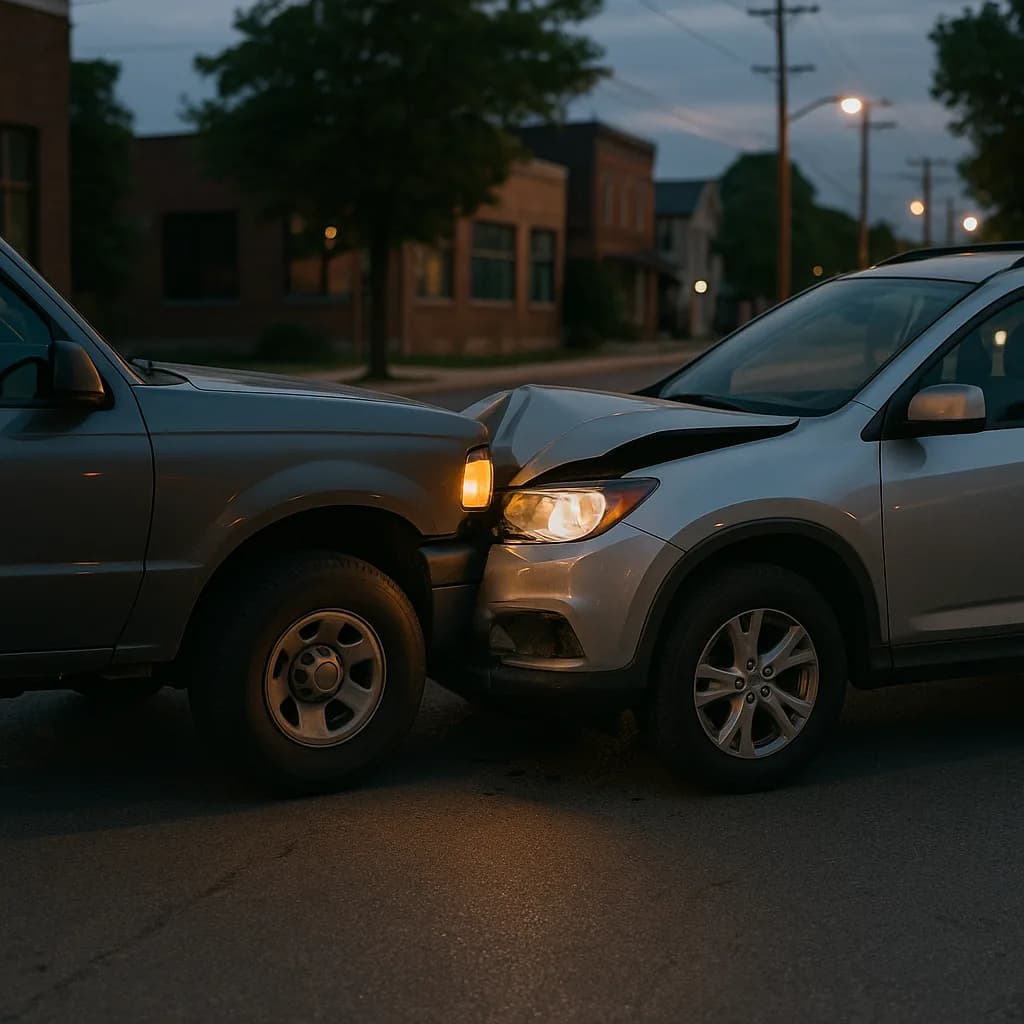
Most first-time drivers choose comprehensive coverage based on cost alone, but the real decision hinges on vehicle value and how you'd replace it after a total loss.
What Comprehensive Coverage Actually Protects
Comprehensive insurance covers damage to your car from nearly everything except a collision with another vehicle or object. This includes theft, vandalism, hail, flood, fire, falling objects like tree branches, and animal strikes — most commonly deer. Your insurance company pays to repair or replace your vehicle up to its actual cash value, minus your deductible (the amount you pay out of pocket before coverage kicks in).
The coverage name confuses most new drivers because "comprehensive" sounds like it covers everything, but it doesn't include collision damage or liability for injuries you cause. If you hit a tree, that's collision coverage. If a tree falls on your parked car during a storm, that's comprehensive. The distinction matters because you can buy one without the other, though most lenders require both if you finance or lease.
Comprehensive typically costs young drivers between $18 and $45 per month depending on the vehicle value, your ZIP code, and your deductible choice. That's substantially less than collision coverage, which averages $65 to $140 per month for drivers under 25, because comprehensive claims tend to be smaller and less frequent.
The Vehicle Value Decision Point
The fundamental question isn't whether comprehensive sounds useful — it's whether your car is worth enough to justify the premium cost. If your vehicle is worth $4,000 and comprehensive costs you $300 per year with a $500 deductible, you're paying to protect $3,500 in value. After two years of premiums with no claims, you've spent $600 to protect an asset that's likely depreciated to $3,200.
Most insurance advisors use the "10% rule" as a starting point: if your annual premium for comprehensive and collision combined exceeds 10% of your car's current value, you're approaching the point where self-insuring makes financial sense. For a car worth $3,000, that threshold is $300 per year or $25 per month. If you're paying $40 per month for both coverages, you're spending $480 annually to protect a depreciating asset — you'd break even on skipping coverage after about six years of no claims.
New drivers often overestimate their vehicle's value because they remember the purchase price rather than checking current market value. A 2015 Honda Civic you bought for $12,000 three years ago is worth approximately $8,500 today. Your comprehensive coverage pays the $8,500 value, not what you paid, so your decision should be based on today's replacement cost, not yesterday's purchase price.
Compare car insurance for first-time drivers
Rates are high for new drivers — but the right carrier and discounts can make a real difference.
Get Your Free Quote✓ New Driver Specialists✓ No Obligation✓ Licensed Carriers✓ All 50 States
How Deductibles Change the Math
Your deductible directly controls your premium cost, and most new drivers choose it backward. The most common deductibles are $250, $500, and $1,000. Jumping from a $250 to a $500 deductible typically reduces your comprehensive premium by 15 to 25%, while moving to a $1,000 deductible can cut it by 30 to 40%. For a young driver paying $35 per month with a $250 deductible, switching to $500 might drop the cost to $28 per month, saving $84 per year.
The financially optimal deductible is the highest amount you could cover from savings without financial stress. If you have $1,200 in an emergency fund and your car is worth $9,000, a $1,000 deductible makes sense because you're trading $10 to $15 per month in savings for a one-time cost you can absorb. But if you have $400 saved and no immediate way to access more, a $250 or $500 deductible prevents you from being unable to repair your car after a covered loss.
The break-even calculation is simple: divide the deductible difference by the annual savings. If raising your deductible from $500 to $1,000 saves you $120 per year, you break even after about four years without a comprehensive claim. Comprehensive claims are filed by roughly 3% of insured drivers annually, meaning most drivers go years between claims — but geographic risk matters significantly. If you live in an area with frequent hail or high vehicle theft rates, the odds shift.
When Comprehensive Is Legally or Contractually Required
If you finance or lease your vehicle, your lender almost certainly requires comprehensive and collision coverage until the loan is paid off. This isn't a legal requirement — no state mandates comprehensive insurance — but it's a contractual one written into your financing agreement. Lenders require it because they hold a financial interest in the vehicle, and if your car is totaled or stolen without comprehensive coverage, you'd still owe the full loan balance with no car to drive.
The required coverage usually includes a maximum deductible, typically $500 or $1,000. If your loan contract specifies a $1,000 maximum deductible and you select $250 to lower your out-of-pocket risk, you're choosing to pay higher premiums for your own benefit, not the lender's requirement. Most new drivers don't realize the lender would accept the higher deductible, costing them $10 to $20 per month unnecessarily.
Once your loan is paid off, the coverage becomes optional immediately — your lender has no ongoing right to require it. Many drivers continue paying for coverage out of habit for months after their final payment without realizing they now have a choice. If your car is worth less than $4,000 at loan payoff and you have savings to replace it, dropping comprehensive can free up $20 to $40 per month immediately.
Common Comprehensive Claims New Drivers Face
The most frequent comprehensive claim for drivers under 25 is glass damage, particularly windshield cracks from road debris. In many states, insurers are required to waive the deductible for glass-only claims, meaning a $600 windshield replacement costs you nothing out of pocket even with a $500 deductible. Florida, Kentucky, and South Carolina have zero-deductible glass laws, while Arizona, Connecticut, Massachusetts, Minnesota, and New York offer it as a no-cost policy option.
Animal strikes are the second most common comprehensive claim, filed by approximately 1.4% of insured drivers each year according to Insurance Information Institute data. Deer collisions peak in November during mating season and cause an average of $4,400 in damage — well above most deductibles. If you commute through rural areas during dawn or dusk hours, your risk is roughly four times the national average, making comprehensive coverage substantially more valuable than the premium suggests.
Theft and vandalism claims vary dramatically by location. A car parked overnight in a ZIP code with a vehicle theft rate above 400 per 100,000 residents faces roughly 10 times the risk of a low-crime suburban area. If you're a new driver living in a high-theft area and parking a commonly stolen model like a Honda Accord or Civic on the street, comprehensive coverage often pays for itself in reduced worry alone, even if you never file a claim. The premium difference between low-risk and high-risk ZIP codes can reach $30 per month for identical coverage on the same vehicle.
How to Decide If You Need It
Start with your car's current market value, not what you paid or what you owe. Check Kelley Blue Book or your insurer's valuation tool for the actual cash value — that's the maximum you'd receive after a total loss. If that number is below $3,000 and you have savings equal to or greater than that amount, comprehensive coverage is probably optional unless you live in a high-risk area for theft, hail, or animal strikes.
Next, calculate your annual cost including the deductible you'd realistically choose. If comprehensive costs $25 per month with a $500 deductible and your car is worth $5,000, you're paying $300 per year to protect $4,500 in value after the deductible. Run that ratio for three years assuming 15% annual depreciation. If the cumulative premium exceeds 50% of your car's projected value at the end of that period, you're approaching the point where self-insuring makes more sense than continuing coverage.
Finally, apply the savings stress test: if your car were totaled or stolen tomorrow, could you replace it with cash or a manageable loan without derailing other financial obligations? If the answer is no and your vehicle is essential for work or school, comprehensive coverage is worth keeping regardless of the value ratio. The premium is buying you time and flexibility, not just vehicle replacement. When you're ready to compare what coverage actually costs for your situation, you can get quotes based on your specific vehicle and location in about three minutes.