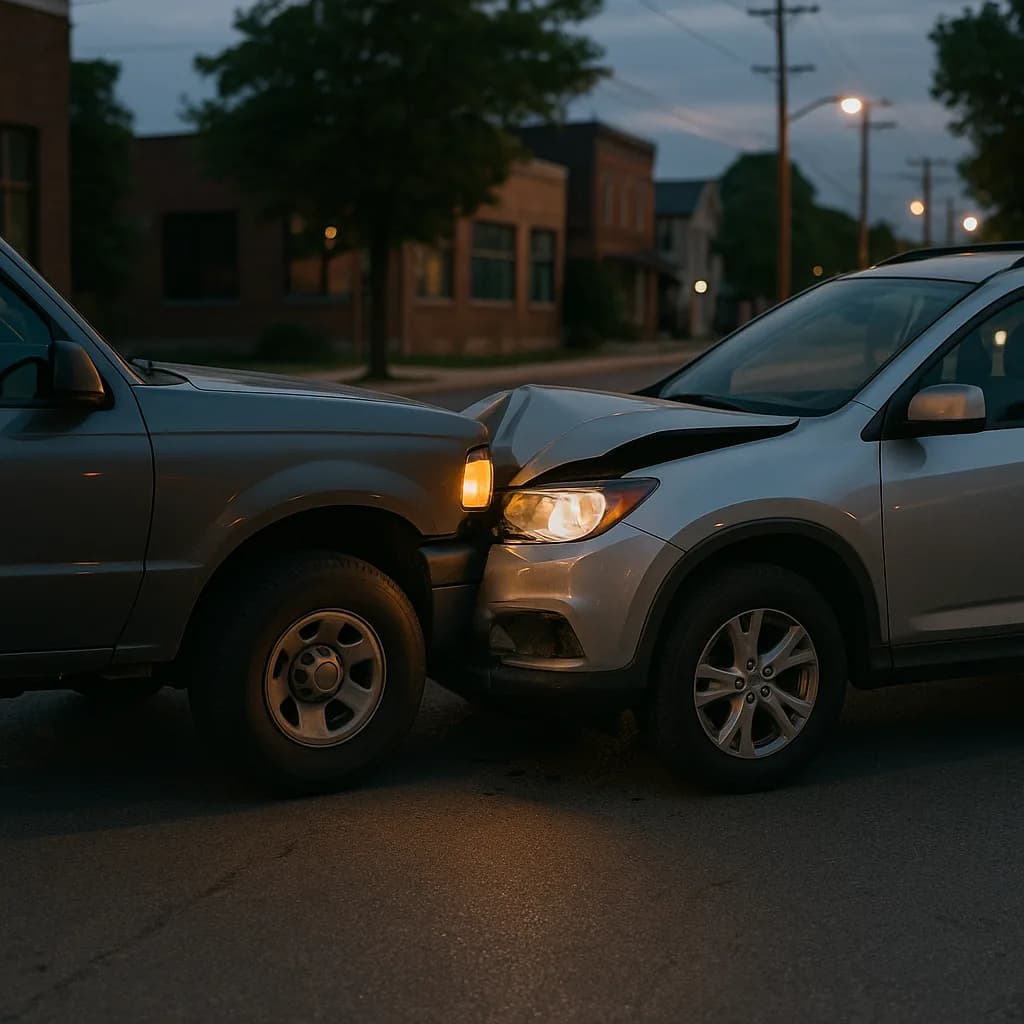
Most first-time drivers buy collision coverage they don't financially need or skip it when it's the only thing protecting their investment. Here's how to decide based on your actual car value and crash risk.
What Collision Coverage Actually Pays For
Collision insurance covers damage to your car when you hit another vehicle, a stationary object like a guardrail or pole, or when your car rolls over — regardless of who caused the crash. This is different from liability insurance, which pays for damage you cause to other people's property and medical bills, but never repairs your own vehicle.
The coverage pays up to your car's actual cash value minus your deductible. If you're driving a 2019 Honda Civic worth $18,000 and you choose a $500 deductible, collision would pay up to $17,500 for repairs after you hit a pole backing out of a parking space. If the repair estimate comes in at $6,200, you pay $500 and the insurer pays $5,700. If the car is totaled — meaning repairs would cost more than the car is worth — you receive $17,500.
Collision coverage is required by your lender if you're financing or leasing your car, but it's optional once the car is paid off. For drivers under 25, collision typically adds $85 to $180 per month to the premium depending on the car's value, your driving record, and your deductible choice. That wide range matters when you're deciding whether the coverage is worth keeping.
The Break-Even Math Most New Drivers Skip
The smartest way to evaluate collision coverage is to calculate how long you'd need to go without a crash for the premiums to exceed what you'd pay out-of-pocket. If collision costs you $120/month and your car is worth $12,000, you'd pay $1,440 per year in premiums. After eight years of coverage without a claim, you've paid $11,520 — nearly the full value of the car.
But crash probability changes the equation. Drivers ages 16-19 have a crash rate roughly three times higher than drivers over 30, according to Insurance Institute for Highway Safety data. If your statistical likelihood of an at-fault crash in the next three years is 35%, the expected cost of going uninsured is $4,200 (35% of $12,000). Compare that to three years of premiums at $120/month — $4,320 — and the math is nearly even.
The threshold where collision stops making financial sense is when your car's value drops below roughly 10 times your annual premium. If you're paying $1,200/year for collision and your car is now worth $10,000, you're approaching the point where self-insuring — setting aside the premium amount in a savings account instead — becomes the better long-term bet. For most first-time drivers, that crossover point happens around year six or seven of ownership.
Compare car insurance for first-time drivers
Rates are high for new drivers — but the right carrier and discounts can make a real difference.
Get Your Free Quote✓ New Driver Specialists✓ No Obligation✓ Licensed Carriers✓ All 50 States
How Your Deductible Choice Changes the Equation
Your deductible is the amount you pay before insurance kicks in. Standard options are $250, $500, $1,000, and sometimes $2,500. Choosing a $1,000 deductible instead of $500 typically lowers your monthly collision premium by $15 to $35, but it also means you're covering the first $1,000 of every repair yourself.
New drivers often choose the lowest deductible because monthly savings feel more tangible than a future crash scenario. But if you can cover a $1,000 expense without financial hardship, the higher deductible saves money over time. At $25/month in savings, you recover the extra $500 deductible cost in 20 months. After that, every month without a claim is pure savings.
The wrong move is choosing a deductible you cannot actually pay if you crash tomorrow. If you pick $1,000 to lower your premium but you'd have to put that repair bill on a credit card at 22% interest, you've turned an insurance decision into a debt trap. Match your deductible to the amount you could cover from savings or family support within 30 days of a crash.
When New Drivers Should Skip Collision Coverage
If your car is worth less than $4,000 and you're paying more than $600/year for collision, you're approaching the point where the coverage doesn't protect meaningful value. A single year of premiums represents 15% of the car's total worth, and after a deductible, a claim might net you $2,500 to $3,000 at most.
Skipping collision makes the most sense when you're driving an older paid-off vehicle, you have enough savings to replace it if totaled, and you have a clean driving record that keeps your rates low elsewhere. For a 22-year-old driver with a 2012 Toyota Corolla worth $5,800 and no loan requirement, dropping collision and banking that $95/month instead builds a $1,140 replacement fund in one year.
But don't drop collision just because the premium feels high. If you're financing a $22,000 car and collision costs $140/month, that's expensive because the coverage is protecting $22,000 in value you'd owe even if the car is totaled. Dropping it violates your loan agreement and leaves you paying off a car you can't drive. The correct move in that scenario is to keep collision and look for a lower rate by comparing quotes across carriers.
What Collision Doesn't Cover That Surprises New Drivers
Collision only pays for crash damage — it won't cover your car if it's stolen, vandalized, hit by a deer, damaged in a hailstorm, or flooded. Those scenarios fall under comprehensive coverage, which is a separate policy add-on. Many first-time buyers assume "full coverage" means everything is covered, but that term just means you're carrying liability, collision, and comprehensive together.
Collision also doesn't cover personal belongings inside your car during a crash. If your laptop or phone is damaged when you rear-end another vehicle, collision pays to fix the car but your renters or homeowners insurance would cover the electronics. And collision doesn't cover normal wear — if your transmission fails or your engine seizes without a crash, that's a mechanical issue, not an insured event.
Another gap: collision pays actual cash value, not replacement cost. If your 2020 Honda Accord was totaled and the insurer values it at $19,500 but a comparable replacement on the used market costs $21,800, you're responsible for that $2,300 gap unless you purchased gap insurance separately. For drivers still making payments, that gap can mean owing money on a car you can no longer drive.
How to Lower Collision Costs Without Dropping Coverage
Raising your deductible from $500 to $1,000 is the fastest way to cut collision premiums, typically saving $180 to $420 per year. The tradeoff is covering more of each repair yourself, but if you're a cautious driver with no recent claims, the probability of needing that coverage in any given year is low enough that the savings compound.
Bundling collision with renters insurance or staying on a parent's policy while listed as an occasional driver can reduce costs by 10% to 20%. Some insurers also offer usage-based programs that monitor your driving through a phone app and discount your rate if you avoid hard braking, rapid acceleration, and late-night driving. For a new driver paying $155/month for collision, a 15% telematics discount saves $23/month — $276 per year.
The biggest variable is the car itself. Collision premiums are based partly on repair costs, so a 2023 Subaru WRX costs significantly more to insure for collision than a 2023 Honda Civic even if both are worth $28,000. If you haven't bought the car yet and collision cost is a factor, compare insurance quotes on two or three models before signing. A $40/month difference in collision premiums is $480 per year — sometimes enough to justify choosing a different vehicle.