If you're under 25 in Pennsylvania, you're likely paying $200-350/month for car insurance on your own policy — significantly more than drivers just a few years older. Here's what drives those numbers and when they drop.
What Young Drivers Actually Pay in Pennsylvania
The average young driver in Pennsylvania pays approximately $200-350 per month for a full coverage policy on their own. That's roughly double what a 30-year-old with the same coverage and driving record would pay. If you're on a liability-only policy because you own an older car outright, expect $100-180/month.
These numbers aren't arbitrary. Pennsylvania carriers price young driver policies based on statewide accident data showing that drivers under 25 are statistically involved in crashes at significantly higher rates than older age groups. The pricing reflects actuarial risk, not a judgment about your specific driving ability. Your rate at 22 with a clean record will still be substantially higher than a 35-year-old with the same clean record.
Your exact rate depends on where you live within Pennsylvania, your coverage limits, your deductible amount, and whether you're carrying collision and comprehensive coverage. Philadelphia and Pittsburgh drivers typically pay 20-30% more than rural Pennsylvania drivers due to higher claim frequency in dense urban areas. If you're financing or leasing your car, your lender will require collision and comprehensive coverage, which adds $80-150/month to a liability-only rate.
The Pennsylvania Minimum Coverage Requirement
Pennsylvania requires all drivers to carry $15,000 per person and $30,000 per accident in bodily injury liability, plus $5,000 in property damage liability. This is written as 15/30/5 in insurance shorthand. This is the legal minimum to register and drive a car in Pennsylvania.
Here's what most young drivers don't realize: the state minimum isn't enough to cover the actual cost of most serious accidents. If you cause an accident that seriously injures another driver, their medical bills can easily exceed $15,000. The remainder comes out of your personal assets — wages, savings, future earnings. For a young driver just starting out financially, that exposure is significant.
Most insurance professionals recommend carrying at least 100/300/100 coverage if you can afford it — $100,000 per person, $300,000 per accident, $100,000 property damage. The difference in premium between state minimum and 100/300/100 is typically $30-60/month, which is meaningful at this budget level but substantially less expensive than paying out of pocket after an at-fault accident. The decision comes down to whether you have assets worth protecting and whether you can absorb the higher monthly cost now.
Compare car insurance for first-time drivers
Rates are high for new drivers — but the right carrier and discounts can make a real difference.
Get Your Free Quote✓ New Driver Specialists✓ No Obligation✓ Licensed Carriers✓ All 50 States
When Your Pennsylvania Rate Drops — and When to Shop
Pennsylvania carriers reduce the inexperienced operator surcharge at three specific milestones: age 21, three years of continuous coverage without a lapse, and age 25. Most young drivers wait until after these milestones to shop for new coverage, which is backward. The right time to request quotes is 30-60 days before the milestone hits.
Here's why timing matters: your current carrier prices you based on your existing record and applies the rate reduction only at renewal after the milestone passes. A competing carrier quoting you 30 days before you turn 21 can price you into the post-21 tier immediately, especially if your policy start date falls after your birthday. You're essentially getting the lower rate a few months early by switching carriers strategically.
The three-year continuous coverage milestone matters as much as age. If you've carried insurance without any lapse since you first got your license, even if you were on a parent's policy for part of that time, you'll see a significant rate reduction once you hit three years of total coverage history. Carriers treat this as evidence of financial responsibility and sustained risk management. A coverage lapse of even 30 days resets this clock in most cases, which is why letting a policy cancel for non-payment is costly beyond just the immediate reinstatement fees.
Parent's Policy vs Your Own Policy: The Long-Term Math
Staying on a parent's policy costs less per month than getting your own — typically $125-200/month added to their existing premium versus $200-350/month for your own full coverage policy. The monthly savings are real. What's less obvious is that staying on a parent's policy doesn't build your own independent insurance history.
When you eventually get your own policy — whether at 23, 25, or 30 — carriers will still treat you as a newly independent policyholder even if you've been driving for years on a parent's plan. You won't get credit for the claim-free years you accumulated under their policy in the same way you would if those years were on your own policy. This means your first independent policy at 25 after being on a parent's plan since 18 will cost nearly as much as it would have at 21.
The decision isn't purely financial. If you're in school, not working full-time, or driving a car your parents own, staying on their policy makes sense. If you're financially independent, own your car, and plan to stay in Pennsylvania long-term, getting your own policy starts building the insurance history that will lower your rates more significantly over the next five years. There's no universal right answer — it depends entirely on your financial situation and timeline.
Discounts That Actually Lower Your Pennsylvania Rate
The good student discount is one of the few young driver discounts that materially affects your premium — typically 10-20% at most Pennsylvania carriers. You'll need to maintain at least a 3.0 GPA and submit proof every semester or academic year. Most carriers don't automatically renew this discount; if you qualified last semester but didn't resubmit documentation, you're paying full rate even if your grades stayed high.
Telematics programs — sometimes called usage-based insurance — monitor your driving through a smartphone app or plug-in device. Pennsylvania carriers offering these programs include State Farm's Drive Safe & Save, Progressive's Snapshot, and Allstate's Drivewise. They measure hard braking, rapid acceleration, late-night driving, and total mileage. For young drivers who don't drive much, work day shifts, and drive cautiously, telematics discounts can reach 15-30%. The flip side: if you frequently drive between midnight and 4 a.m. or commute in heavy traffic with frequent hard braking, the program may not save you anything.
Bundling your auto policy with renters insurance typically saves 5-15% on the auto portion and gives you renters coverage for $15-25/month. If you're renting an apartment in Pennsylvania, this is one of the few discount strategies that also gives you additional coverage rather than just reducing the cost of coverage you already carry. Paying your premium in full rather than monthly typically saves 3-5% annually, but requires having the full six-month premium available upfront.
Collision and Comprehensive: When It's Worth the Cost
Collision coverage pays to repair or replace your car if you crash it, regardless of fault. Comprehensive coverage pays if your car is stolen, vandalized, hits an animal, or is damaged by weather. Together, these coverages typically add $80-150/month to a Pennsylvania policy for a young driver, depending on the car's value and your chosen deductible.
If you're financing or leasing your car, this isn't a choice — your lender requires both coverages as a condition of the loan. If you own your car outright, the decision is purely financial: does the coverage cost less than the benefit you'd receive if you totaled the car? For a car worth $3,000, paying $100/month for collision and comprehensive means you'll pay $1,200 per year to insure a $3,000 asset. After three years, you've paid more in premiums than the car is worth.
The deductible you choose directly affects your monthly premium. A $500 deductible costs significantly more per month than a $1,000 deductible — typically $15-30/month difference. The question is whether you could cover a $1,000 repair out of pocket if you needed to. If you don't have $1,000 in accessible savings, the lower deductible makes sense even though it costs more monthly. If you do have that cushion, the higher deductible saves you money over time unless you file a claim within the first two years.
What Happens After Your First Ticket or Accident
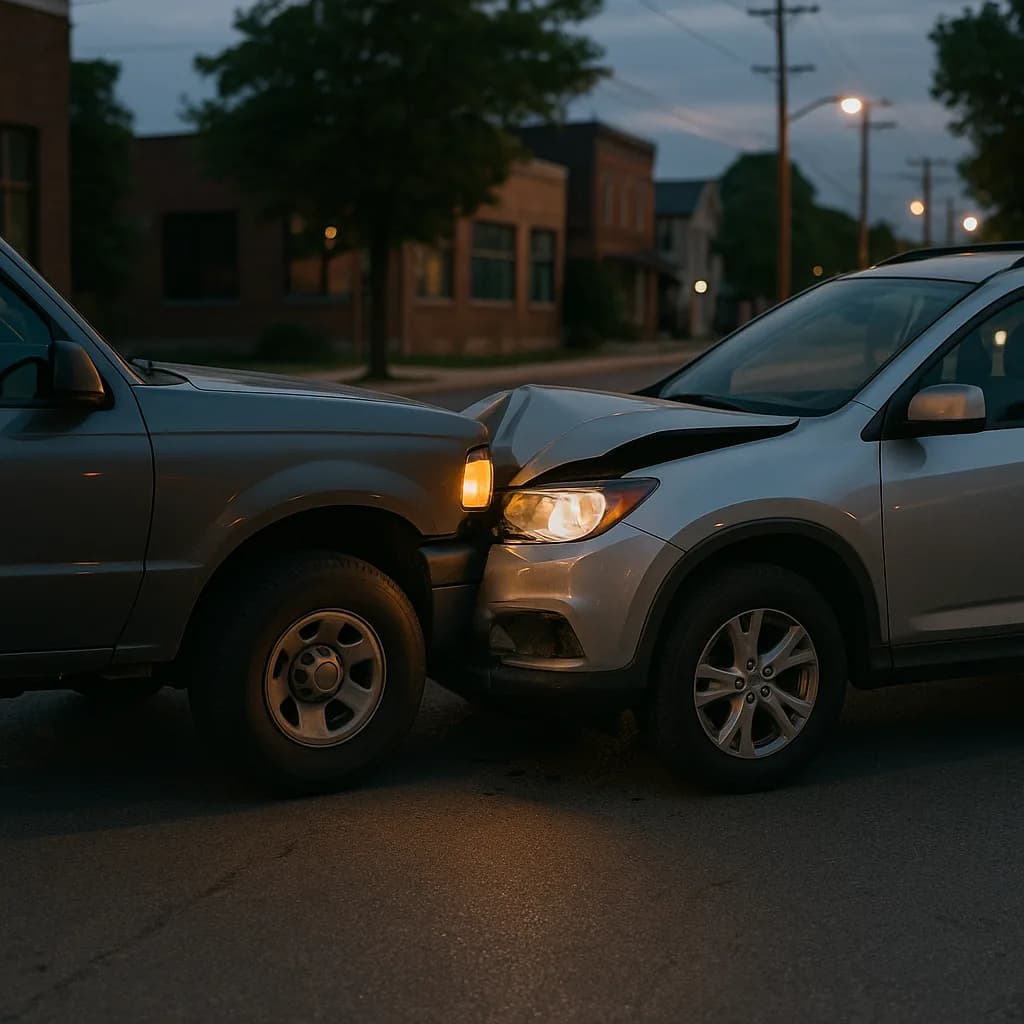
A single at-fault accident in Pennsylvania typically increases your premium by 20-40% at renewal, which translates to $40-100/month for most young drivers. A speeding ticket adds roughly 15-25% depending on how far over the limit you were cited. These surcharges stay on your record for three years from the incident date in Pennsylvania.
This is where the long-view calculus matters. If you're paying $250/month now and get into an at-fault accident, your rate jumps to $300-350/month for the next three years. That's an additional $1,800-3,600 over the surcharge period. Some young drivers consider dropping collision coverage after an accident to offset the surcharge, but this only makes sense if the car is fully paid off and worth less than a few thousand dollars.
Pennsylvania uses a points system for traffic violations, and accumulating six points within two years triggers a mandatory driver improvement hearing. Points affect your insurance rate separately from how carriers surcharge violations. A speeding ticket that adds three points to your license will increase your insurance premium even if you attend traffic school to reduce the points, because carriers track the underlying violation independently from the state's point system.