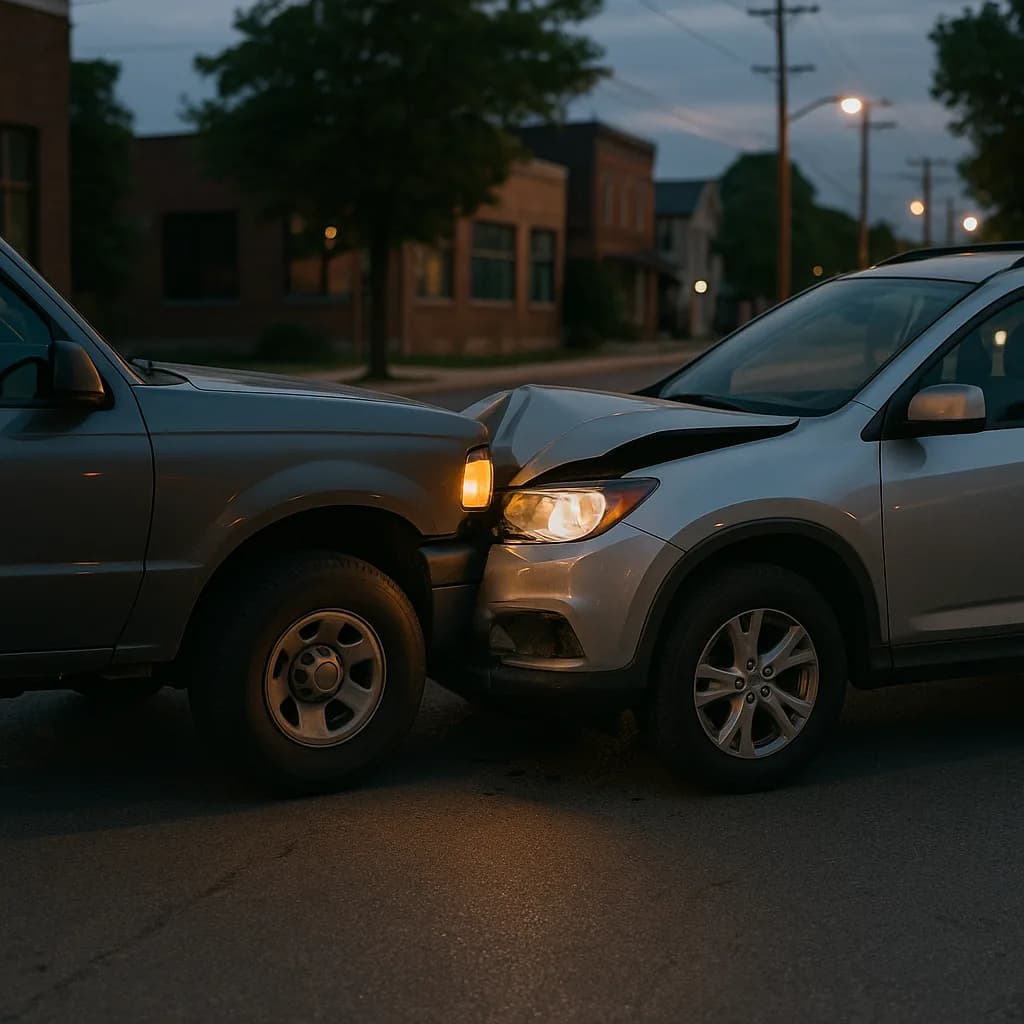
Illinois first-time drivers face coverage minimums that leave serious financial gaps, rate factors you can control in the first 90 days, and discount eligibility that starts before you even get quotes.
Why Illinois First-Time Driver Rates Start Higher Than Experienced Drivers
You just got your license or your first car, searched for Illinois insurance rates, and likely saw numbers that feel impossible—$200 to $400 per month or more. That's not an error. Insurance companies charge first-time drivers in Illinois between 50% and 120% more than drivers over 25 with clean records because actuarial data shows new drivers file claims at nearly double the rate of experienced drivers during their first three years on the road.
The premium you're quoted—the amount you pay monthly or every six months to keep your policy active—reflects three specific risk factors insurers weight heavily for first-time buyers: zero claims history to prove you're a safe driver, limited years of licensed driving experience, and age demographics if you're under 25. A 20-year-old first-time driver in Chicago typically pays $320 to $380 per month for minimum coverage, while a 35-year-old first-time driver in the same ZIP code pays $180 to $240 for identical coverage.
Illinois doesn't prohibit age-based pricing, so carriers legally charge younger first-time drivers more even when driving records are identical. The rate gap narrows significantly after your first policy renewal if you maintain a clean record—most carriers reduce premiums 10-15% at six months and another 10-20% at 12 months for claim-free first-time drivers.
Illinois Minimum Coverage Requirements and Why They're Not Enough
Illinois law requires all drivers to carry liability insurance with minimum limits of 25/50/20: $25,000 for injury or death of one person, $50,000 for injury or death of multiple people in one accident, and $20,000 for property damage. This is what you must have to legally register a vehicle and avoid penalties, but these minimums create dangerous financial exposure for first-time drivers.
If you cause an accident that injures another driver seriously enough to require surgery or extended hospital care, medical bills can easily exceed $100,000. Your $25,000 liability limit pays only the first $25,000—you're personally responsible for the remaining $75,000, which can result in wage garnishment, asset seizure, or bankruptcy for a driver just starting out. A single totaled luxury vehicle in a parking lot collision can generate $60,000 in property damage; your $20,000 limit leaves you owing $40,000 out of pocket.
Most insurance advisors recommend first-time Illinois drivers carry 100/300/100 liability limits instead—$100,000 per person, $300,000 per accident, $100,000 property damage. This upgrade typically adds $40 to $80 per month to your premium but protects you from financial ruin in a serious at-fault accident. The monthly cost difference between state minimums and 100/300/100 coverage is almost always smaller than the potential out-of-pocket liability gap.
Compare car insurance for first-time drivers
Rates are high for new drivers — but the right carrier and discounts can make a real difference.
Get Your Free Quote✓ New Driver Specialists✓ No Obligation✓ Licensed Carriers✓ All 50 States
Coverage Types You'll Choose When Building Your First Illinois Policy
When you request quotes, you'll build your policy by selecting coverage types and limits. Beyond the liability minimum discussed above, you'll decide whether to add four optional coverages—each protects against different financial risks.
Collision coverage pays to repair or replace your car after an accident you cause, regardless of fault in some cases. Comprehensive coverage pays for damage from non-collision events—theft, vandalism, hail, hitting a deer, or flooding. Both require you to choose a deductible, the amount you pay out of pocket before insurance coverage begins. A $500 deductible means you pay the first $500 of repair costs and your insurer pays the rest. Higher deductibles ($1,000 or $1,500) lower your monthly premium by 15-30% but require more cash available if you file a claim.
Uninsured motorist coverage protects you when a driver with no insurance injures you or damages your car—a critical addition in Illinois, where approximately 14% of drivers operate without insurance according to Insurance Research Council estimates. Medical payments coverage pays your medical bills after an accident regardless of fault, typically offering $1,000 to $10,000 in coverage for around $5 to $15 per month.
If you financed or leased your vehicle, your lender will require both collision and comprehensive coverage until the loan is paid off. If you own your car outright and it's worth less than $3,000, you might skip these coverages and pay out of pocket for repairs—but only if you have savings set aside to replace the vehicle if it's totaled.
Discounts You Can Secure Before You Even Request Quotes
Here's what most first-time driver guides miss: Illinois carriers offer 8 to 12 standard discounts, but three of the largest—defensive driver training, good student, and bundling—require documentation you should gather before you start shopping, not after you've already locked in a rate.
Completing an approved defensive driving course before requesting quotes qualifies you for a defensive driver discount worth 5-10% on most Illinois carriers. The course costs $25 to $50, takes 4 to 6 hours online, and the completion certificate remains valid for three years in most cases. If you're paying $250 per month, this discount saves $15 to $25 monthly, recovering the course cost in the first two months and saving $540 to $900 over three years.
If you're under 25 and enrolled in college, gather proof of a 3.0 GPA or higher (a current transcript or grade report) before shopping. The good student discount reduces premiums by 10% to 20% at most major carriers—one of the largest single discounts available to first-time drivers. Some insurers require you to submit documentation with your application; others verify eligibility after binding coverage. Having proof ready prevents delays and ensures the discount applies from day one.
Bundling your auto policy with renters insurance—even if you live with parents or roommates—can unlock a multi-policy discount worth 10-15%. Renters insurance costs $12 to $20 per month for $20,000 in personal property coverage and $100,000 in liability protection, and the bundling discount often exceeds the cost of the renters policy itself, creating a net monthly savings while adding valuable coverage for your belongings.
When Illinois Requires an SR-22 Filing for First-Time Drivers
Some first-time drivers in Illinois need to file an SR-22 before they can get licensed or insured—this is common if you're getting your license reinstated after a suspension, were caught driving without insurance, or received a DUI before ever holding a standard policy.
An SR-22 isn't insurance—it's a certificate your insurance carrier files with the Illinois Secretary of State proving you carry at least the state minimum liability coverage. The state requires continuous SR-22 filing for one to five years depending on the violation, and if your policy lapses or cancels for even one day, your insurer notifies the state and your license suspends again immediately.
SR-22 filings themselves cost $15 to $50 as a one-time or annual processing fee, but the underlying insurance premiums increase dramatically. First-time drivers requiring an SR-22 pay 60% to 150% more than standard first-time driver rates because the SR-22 requirement signals high-risk behavior to insurers. A first-time driver in Illinois paying $280 per month for standard coverage might pay $450 to $700 per month with an SR-22 requirement.
How to Compare Quotes and Choose Your First Illinois Policy
You should request quotes from at least four carriers—rates for identical coverage vary by $100 to $200 per month between the most and least expensive options for first-time Illinois drivers. When comparing, confirm every quote reflects the same liability limits, deductibles, and coverage types, or you're comparing different products.
Don't choose based solely on the monthly premium. Check the company's financial strength rating (A.M. Best rates insurers A++ to F), claims satisfaction scores, and whether they offer local agents or app-based service depending on your preference. A carrier that's $30 per month cheaper but takes 45 days to process claims and offers no local support costs far more in frustration and delayed repairs than you save in premiums.
Once you've selected a carrier, you'll typically need to provide your driver's license number, vehicle identification number (VIN), current odometer reading, and payment information to bind coverage. Most Illinois insurers allow you to start coverage the same day or select a future effective date up to 30 days out. If you're buying or registering a vehicle, coordinate your policy effective date to match your purchase or registration date—driving even one day without active coverage risks license suspension, fines up to $1,000, and vehicle impoundment.