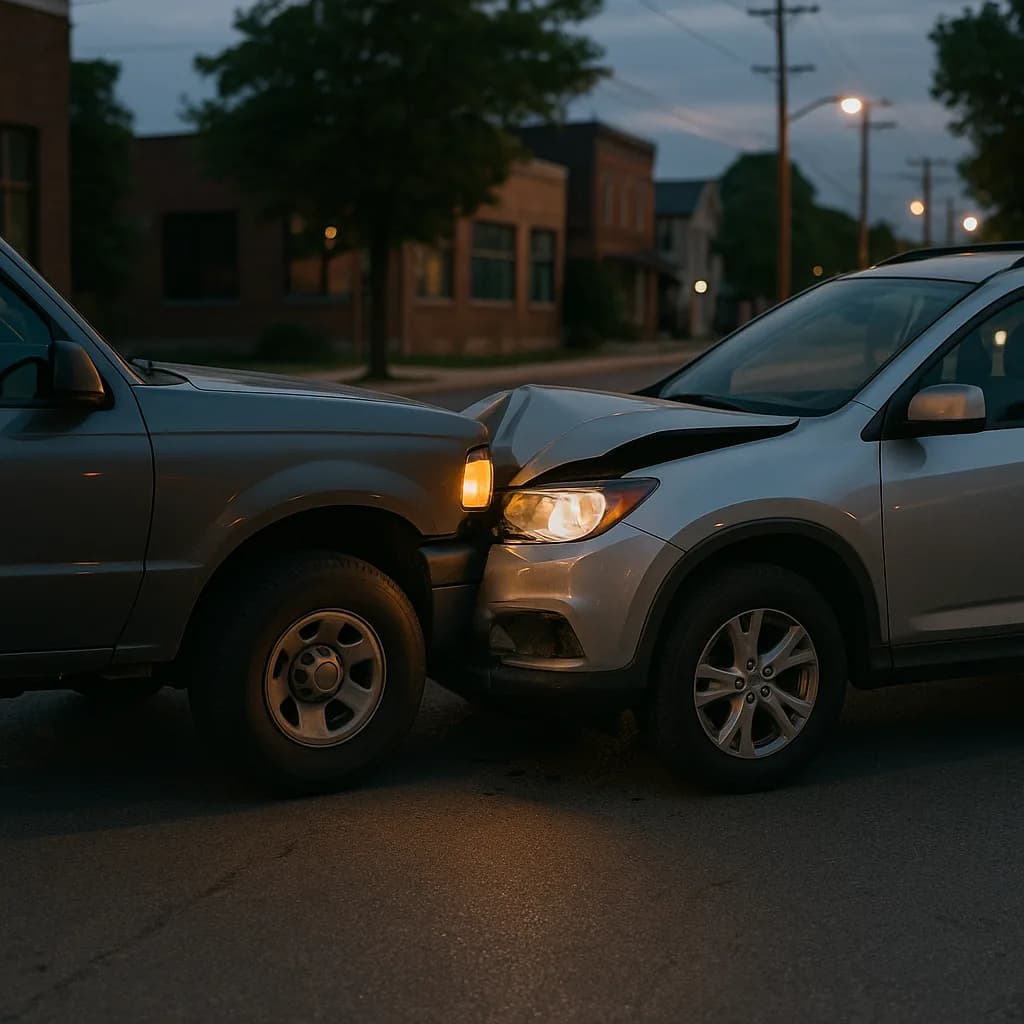
California minimum coverage saves $150–200/mo upfront but can cost $30,000+ out-of-pocket in a serious crash. Here's how to calculate which tier matches your actual financial risk.
Why the Monthly Savings Number Misleads New Drivers
You just got quoted $340/mo for full coverage and $180/mo for California minimum coverage as a first-time driver. The $160 monthly difference feels massive when you're budgeting your first solo policy, but that comparison ignores the coverage gap you're buying into. California's minimum property damage limit is $5,000, while the average vehicle you'll hit in an at-fault crash is worth approximately $28,000 according to Kelley Blue Book data. That $23,000 gap comes directly from your bank account, your wages, or your future earnings through a judgment.
The premium (the amount you pay monthly for coverage) reflects your risk profile as a first-time driver, which California insurers price 60–80% higher than a driver over 25 with three years of history. The deductible (what you pay out-of-pocket before insurance covers a claim) matters, but it's capped at $500–$2,500 depending on your selection. The liability limit (the maximum your insurer pays for damage you cause) is where unlimited financial exposure enters the equation for minimum coverage buyers.
When you carry only California's required minimums—$15,000 per person for injury, $30,000 per accident for injury, and $5,000 for property damage—you're personally liable for every dollar beyond those thresholds. For a first-time driver statistically more likely to cause a severe crash, that exposure isn't theoretical.
What California Minimum Coverage Actually Covers
California requires liability insurance with 15/30/5 limits. That breaks down as $15,000 maximum per injured person, $30,000 maximum per accident for all injuries combined, and $5,000 maximum for property damage. If you rear-end a single vehicle worth $32,000 and injure the driver who needs $18,000 in medical care, your minimum policy pays $15,000 toward medical and $5,000 toward the vehicle. You're personally responsible for the remaining $3,000 in medical costs and $27,000 in vehicle damage—$30,000 total.
Minimum coverage includes nothing for your own vehicle. If you cause the crash, your car damage is entirely your expense. If someone without insurance hits you, you have no uninsured motorist coverage unless you add it separately. Approximately 16.6% of California drivers are uninsured according to the Insurance Information Institute, meaning one in six crashes involves someone who can't pay for your damage.
This tier makes financial sense only when you drive a vehicle worth under $3,000, have no assets to protect from a lawsuit, and can absorb a $5,000–$10,000 loss from an uninsured driver hitting you. For most first-time drivers with a financed vehicle or any savings, minimum coverage transfers risk onto your personal balance sheet at the worst possible time.
Compare car insurance for first-time drivers
Rates are high for new drivers — but the right carrier and discounts can make a real difference.
Get Your Free Quote✓ New Driver Specialists✓ No Obligation✓ Licensed Carriers✓ All 50 States
What Full Coverage Adds and What It Costs
Full coverage typically means liability limits of 100/300/100 ($100,000 per person injury, $300,000 per accident, $100,000 property damage), plus collision and comprehensive coverage for your own vehicle. Collision coverage pays to repair or replace your car when you cause a crash, regardless of fault. Comprehensive coverage handles theft, vandalism, fire, flood, and animal strikes. Both come with a deductible you select—usually $500, $1,000, or $2,000.
For a first-time driver in California, full coverage typically runs $280–$450/mo depending on your zip code, vehicle, and driving record, while minimum coverage runs $150–$220/mo. The $130–$230 monthly difference buys you protection against $95,000 more in liability exposure and complete coverage for your own vehicle damage minus your deductible. If you're financing a car, your lender requires collision and comprehensive until the loan is paid off, making this decision automatic.
The break-even math changes based on your vehicle's value. If you drive a 2018 Honda Civic worth $18,000 and pay $180/mo extra for full coverage versus minimum, you break even after 100 months if you total the car with no collision coverage. But the real value isn't the vehicle replacement—it's the liability protection. One at-fault crash causing $60,000 in injuries and property damage costs you $55,000 out-of-pocket with minimum coverage, but $0 with 100/300/100 limits.
The Third Option Most Agents Don't Calculate
You can build a middle-tier policy that outperforms both extremes: carry high liability limits (100/300/100) without collision coverage if you drive an older vehicle you can afford to replace. For a first-time driver with a 2012 sedan worth $6,000, this configuration typically costs $200–$260/mo in California—only $20–$40/mo more than minimum coverage, but with $95,000 more liability protection.
This approach works when your vehicle value is low enough that you can self-insure the replacement cost, but your liability exposure remains high because you're still sharing the road with $50,000 SUVs and causing the same injury risk as any driver. You keep the catastrophic financial protection where you need it most—covering someone else's damages—while accepting the vehicle replacement risk yourself.
Add uninsured motorist coverage to this middle tier for an additional $15–$30/mo. This covers your injuries and your vehicle damage when an uninsured driver hits you, closing the gap that minimum liability leaves open in one-in-six California crashes. The total monthly cost remains $100–$150 below full coverage while eliminating the six-figure personal liability risk that minimum coverage creates.
How to Decide Based on Your Actual Financial Position
Calculate three numbers before choosing a tier. First: your vehicle's current value using Kelley Blue Book or a similar tool. Second: your available savings that you could deploy immediately after a crash without destroying your financial stability. Third: your monthly insurance budget ceiling—the maximum you can pay without cutting into rent, debt payments, or food.
If your vehicle is worth more than three months of the coverage price difference, collision coverage pays for itself in any total-loss scenario within the first year. If your available savings are less than $15,000, you cannot safely absorb the out-of-pocket exposure from a moderate at-fault crash on minimum coverage. If your budget ceiling is genuinely below the cost of high-liability-only coverage, minimum coverage becomes your only legal option, but recognize you're trading monthly affordability for massive deferred financial risk.
For most first-time drivers in California, the optimal path is 100/300/100 liability limits plus collision only if the vehicle is worth more than $8,000 or financed. This typically lands between $220–$320/mo depending on your location and driving profile—higher than minimum, lower than full coverage, and calibrated to your actual exposure. The savings from dropping comprehensive (theft, vandalism, weather damage) are usually $20–$40/mo, which rarely justifies losing that protection unless you park in a secured garage and live outside high-theft zip codes.